
This information is for leaders, wellbeing staff and teachers in primary schools to support them to better understand distress and self-harm in the context of primary-aged children.
Be You is also hosting a series of online, cross-sector workshops to support your school to implement the Responding to distress, including self-harm: A guide for Australian primary schools.
On this page
Download this Fact Sheet:
Fact Sheet: Distress and self-harm in primary schools (2.4 MB, PDF)
Distress in primary-aged children
Distress involves intense unpleasant thoughts and emotions that affect a child’s level of functioning and interfere with the activities of daily living. Children experiencing distress can respond in various ways, including:
- challenges with emotional regulation
- heightened emotions (e.g. anger, aggressive behaviours) or internalised emotions (e.g. isolation, withdrawal, daydreaming)
- psychosomatic complaints (e.g. stomach aches, headaches, regularly asking to go to the sick bay, or asking to be picked up to go home)
- poor concentration or decrease in academic performance
- self-harming behaviours.
Self-harm in primary-aged children
Self-harm is when a person deliberately causes pain or hurts themselves – usually as a means of coping with difficult emotions when they feel under pressure or distressed.
Self-harming behaviours that educators might notice in children include:
- head banging
- self-hitting
- severe scratching and skin picking
- hair pulling (including body hair)
- cutting
- interfering with wound healing
- restricting food intake
- running recklessly across the road.
Why do children self-harm?
When a child is experiencing distress and self-harming, they will be experiencing emotions that they are unable to manage or regulate on their own.
Some of the risk factors for self-harm in children include experiencing bullying and isolation, a lack of supportive peer relationships, mental health challenges including depression and anxiety, family conflict, and the experience of child maltreatment.
It’s important to note that many children who engage in self-harming behaviours do not have a mental illness or suicidal thoughts, however self-harm is a risk factor for suicide and on rare occasions result in accidental death. It’s not the role of educators to determine the intent of a child engaging in self-harm, as the same immediate response applies for schools to follow their policies and procedures.
It is essential that educators view self-harming behaviours as responses to overwhelming emotions that the child is having trouble managing on their own.
Self-harm should be seen as connection seeking, not attention seeking.
Key considerations for primary school educators
Understand distress and ages and stages of development
Expressions of distress can vary significantly between children in the early and upper primary years. Developmentally younger children are more likely to express distress through physical or behavioural responses, such as head banging, hair pulling or emotional outbursts. Developmentally older children may display more deliberate behaviours that cause injury, such as skin picking and cutting.
Most children who engage in self-harm do so without intending to end their life. A child’s understanding of death and its permanency depends on their age and stage of development. Research has shown that children aged 4-6 view death as temporary and reversible. By around age 7, children generally understand that death is permanent. By around 10-12 years of age, children have a similar understanding of death to adults and can comprehend suicide as a concept.
For many younger children, self-harming behaviour may function as a form of communication rather than an expression of suicidal intent. Children may engage in behaviours to signal distress, unmet needs, confusion, or emotional pain when they lack the language, cognitive capacity, or emotional skills to articulate their experiences verbally. In some cases, children may not recognise that their behaviour is harmful or may not associate it with long-term consequences. Instead, the behaviour can be understood as an attempt to cope with overwhelming feelings or to elicit care, safety, or connection from trusted adults. Interpreting such behaviours through a developmental and relational lens supports responses that prioritise understanding, emotional containment, and the child’s underlying needs, rather than focusing solely on the behaviour itself.
Involve the family
Families play an essential part of the wider school community. They hold unique knowledge of their child. Responding to distress and self-harm must involve parents/carers who the child has a safe relationship with. It is important to communicate openly, without judgement, and work collaboratively to support the child. While the definition of families is broad, educators must ensure they contact the parent/carer nominated by the family, in line with the school’s policies and processes.
Be You‘s Partner module provides strategies and skills for communicating with families, while the Inquire module looks at how educators can have difficult conversations around mental health concerns.
Model emotional regulation
Primary school educators recognise that children learn behaviour and emotional regulation through observation and imitation of others around them. The actions, language used, and emotional responses of educators have a strong influence on how children understand and express their distress. It is important for educators to model calm, compassionate and regulated responses not only during times of heightened stress, but also when responding to a child’s distress or self-harm.
Promote secure attachment
While families are the child’s main attachment figures, educators should build secure and responsive relationships with children. This acts as an essential protective factor, and provides children with safety, reassurance and regulation, particularly during times of distress.
Understand social transmission
Children can be exposed to self-harming behaviours through their peers, siblings and online. They may see another child self-harming or see wounds or injuries, or they may hear about another child self-harming. This exposure can increase the risk of the child engaging in self-harm. They might also be encouraged by a friend to join the behaviour as a form of belonging or to demonstrate their empathy towards a friend who is experiencing distress. Children should be encouraged to share with educators any concerns they may have about a peer self-harming and provided with ongoing support.
Safely talk about self-harm
Children sometimes disclose or discuss personal experiences in the classroom or school environment. This can include talking about their own self-harming behaviours or showing peers their injuries. This must be handled with care as research suggests children who are vulnerable or who may be at increased risk can be adversely affected by hearing details of another child’s story or experience of self-harm.
Schools should have a basic plan for responding to and managing these conversations. It can be helpful to prepare responses in advance so when faced with a difficult conversation it is easier to think of a sensitive way to divert it. If educators overhear a child talking about self-harming, they should engage protective interruption as a strategy to prevent the child from sharing details in front of their peers while giving them the opportunity to safely and confidentially disclose in an appropriate setting and time. This might sound like, “It sounds like you have something serious to share. Let’s pause for a moment and see if we can find the best person for you to chat to about this”, or “Sometimes we hear about things that feel confusing or scary. We don’t need to hear about all the details now, but why don’t we chat more about this after class/at snack/at lunch.”
Build social and emotional wellbeing
Self-harm rates are rising in adolescence which highlights the importance of taking a preventative approach in childhood. Educators play a key role in building social and emotional skills in children through intentional teaching and incidental interactions to support children to develop healthy coping skills and help-seeking behaviours.
Challenge misconceptions
A common misconception is that children self-harm for attention. However, many children harm themselves in places that are not visible or are easily covered by clothes. The self-harming behaviours are often done in private, and families are often unaware that the child is self-harming.
Often self-harm in boys is ignored or minimised due to the assumption that self-harming behaviours are mainly exhibited by girls. A key difference between primary and secondary aged children is that prior to age 12, self-harm is between 1.2 – 3 times more prevalent among boys than same-age girls.
A key misconception is that self-harm is a trend. While there is a risk of social transmission as noted above, it is important for educators to view each child individually and support them to cope with their distress in healthier ways. It is important not to dismiss or downplay self-harm behaviours displayed by any child.
Principles for responding to distress, including self-harm
There are six key principles to consider when responding to distress, including self-harm in primary-aged children. Incorporating these principles in the educator’s response will help to reduce harm, promote trust, and support the child.
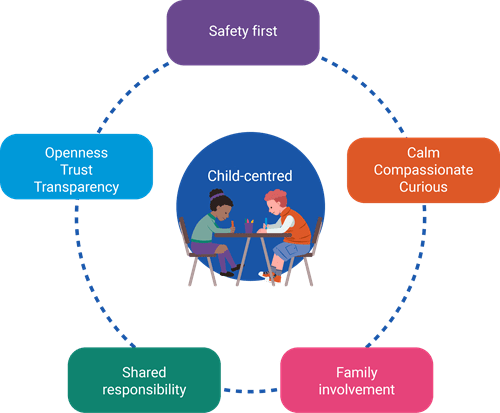
Firstly, it is essential that educators take a child-centred approach to responding to children who show signs of distress or self-harm. A priority is considering any immediate safety needs of the child. It is important for the educator to remain calm and compassionate when engaging with the child, and to be professionally curious rather than judgemental. It is important that educators remain within scope of their role and collaborate with the child’s parents/carers and other professionals, and to sensitively inform children of the need to inform parents/carers and other relevant school staff so that they can best support the child.
headspace’s Responding to distress including self-harm: A guide for Australian primary schools, provides more detailed guidance on responding to self-harm.
Responding to distress including self-harm: A guide for Australian primary schools (380.9 KB, PDF)
Providing support to children who self-harm
Most people who self-harm don’t seek professional help, so educators play an important role in assisting children to get the professional support they need. Educators can provide continued support within the school context by:
- reaching out to children when they show signs of distress or self-harm
- listening to children when they share how they are feeling in a curious, non-judgemental way
- taking action if concerned about a child who is self-harming by following the school’s policies and procedures
- supporting the friends of children who self-harm.
It is essential that educators understand the limitations of their role. It is not the role of classroom educators or leadership staff to diagnose mental health difficulties, determine the reason or intent of distress or self-harm, or to undertake a risk assessment. These are the role of a trained mental health professional who can work with the child to understand underlying challenges and to ensure safety and restore wellbeing.
The My Return to School Support Plan
Some children may need some time away from school to manage their distress or self-harm. Returning to school can be a protective factor for children. It can be helpful in their recovery, especially when the school has worked to create a supportive and protective environment. The child may feel anxious about returning to school and will need additional support and understanding. With these considerations in mind, educators can play a crucial role in supporting the child and assisting with a successful transition back to school.
A My Return to School Support Plan (the Plan) aims to ensure the best possible reintegration, safety, care and support for a child who’s returning to school. It should include strategies that aim to keep the child safe, supported and connected with staff and peers. It outlines situations the child might find difficult, and how these can be managed to help them feel safe and supported.
An up-to-date risk assessment should also be available when completing the Plan, as this will guide the level of support and care provided to the child. If the school doesn’t have access to a recent risk assessment, one should be completed by an appropriately trained staff member before the Plan is written.
The Plan is ideally written with the child, their family, school wellbeing staff and any mental health professionals involved in the child’s care. It should be completed before the child returns to school. If this hasn’t happened, school wellbeing staff should complete the Plan as a priority when the child does return.
The process for this planning may include:
- Scheduling a Return to School Meeting with the child, their family, their health care professionals, key school staff and school wellbeing staff to discuss the child’s needs and develop a My Return to School Support Plan.
- Documenting decisions, actions and outcomes.
- Making regular contact with the child and their family to discuss their progress and any concerns or developments.
Be You has a My Return to School Support Plan template you can use.
My Return to School Support Plan: Primary School (1.2 MB, PDF)
Key components of the My Return to School Support Plan
Identify a key support person at school
Ideally, this educator is a wellbeing staff member who has some mental health training and understands the needs of children at risk. However, the child should be encouraged to choose someone who they trust and feel comfortable with. Encourage them to choose an educator who is easy to approach, has time to offer support and who understands how they can help. If the child chooses an educator who’s not well placed to be a support person, find other ways for this trusted educator to be involved in the Plan.
The key support person should act as the school liaison with the family and external mental health service providers. They’ll also be the key contact the child goes to if they need additional support or assistance during school hours. Consider identifying more than one key support person in case they are absent or unavailable to support the child when required.
Negotiate the details of the My Return to School Support Plan
It’s important that the Plan is child-centred and completed with the child. Educators should guide discussion and suggestions around strategies and support the child to come up with their own. The child’s active involvement in the development of the Plan will ensure the information is meaningful and helpful, and therefore more likely to be used when required. If the child is involved in decisions about their return to school, it’s also likely to influence their re-engagement and successful reintegration into school.
If educators believe the child’s suggestions are unrealistic or unmanageable, it’s important to discuss this openly with them, giving clear reasons and alternatives. The school’s duty of care needs to be considered, so it may also be necessary to talk about the limits of what the school can offer.
It may be appropriate to consider:
- A gradual return to school until the child feels well enough to attend full-time.
- Assistance to prioritise catching up on missed schoolwork. The child’s length of absence from school will determine how much schoolwork they’ve missed. This may feel quite overwhelming for them. Depending on the time missed, it may be worth considering amendments, extensions or exemptions for missed work, assessments or tests.
Develop a collaborative approach to support the child at school
It’s not the sole responsibility of the school to support a child who is distressed or self-harming, but it can play a key role. Where possible, it’s preferable that the child engages with an external mental health service or general practitioner (GP) before returning to school. Ideally, families should also play a central role in supporting the child in their return to school. Regardless of the individuals involved, there needs to be a collaborative approach to sharing information and delineating responsibility.
Clarify information sharing, confidentiality and consent
A school can only obtain information about a child’s admission or treatment from a hospital, mental health or health service, community agency or support program with the consent of the child’s family. This means educators may not be able to obtain even basic information, such as whether a child has become a client of a service, without the service having sought and obtained prior consent for the school to receive this information. Consent is usually given in writing and, ideally, signed by an appropriate family member. Service procedures can vary, so seeking clarification from the service about its consent procedures is vital if the information a school requires isn’t being provided.
Schools can request a service seeks permission from families so information can be shared with the school. A school, through its wellbeing team, can also introduce its own consent or permission procedure. The school can obtain consent from families for information to be shared with the school, prior to the referral of the child. Schools can also play a proactive role in negotiating information-sharing protocols with agencies and programs used by children as part of student wellbeing practice.
Decide who has access to the My Return to School Support Plan
Key school staff involved with the child should be given relevant information about how to assist the child in class time, while on school grounds, and on excursions and camps. They don’t need access to detailed clinical information or the complete Plan as these can contain confidential information. However, they should be provided with the information that affects how they approach or support the child. This could include who the child’s support people are at school, factors that could lead to the child self-harming, and strategies that have been identified to support the child and help them manage distress. The family should also receive a copy of the Plan.
After the child returns to school
Returning to school after experiencing distress or engaging in self-harm can be a difficult time for the child. They may feel anxious about what other people are thinking, nervous about how they’ll cope, or worried about catching up on the work they’ve missed. Once they’ve returned, the priority is to ensure they feel supported and able to return to their normal routine. The Notice, Inquire, Provide (NIP) early intervention framework can help educators to monitor a child on their return to school. You can find out more about the NIP framework in the Early Support domain of the Be You Professional Learning.
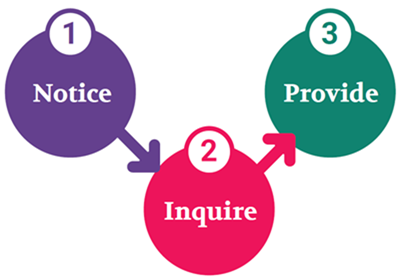
A key part of an educator’s role after a child returns to school is to monitor their wellbeing. As there are often multiple staff involved in a child’s learning, it can be helpful for all staff to understand what to look out for when supporting a child. Changes in mood, levels of participation and thinking patterns may indicate that the child needs extra support.
Changes in mood include:
- being irritable or angry with friends or family for no apparent reason
- feeling tense, restless, stressed or worried
- crying for no apparent reason or feeling sad or down for long periods of time.
Changes in levels of participation include:
- not enjoying or not wanting to be involved in things they’d normally enjoy
- being involved in risky behaviour they would normally avoid
- unusual sleeping or eating habits.
Changes in thinking patterns include:
- having a lot of negative thoughts or expressing distorted thoughts about themselves and the world (for example, everything seeming bad and pointless).
If educators become aware of changes in a child, it’s important that action is taken. They might be able to have a conversation with the child, or they might refer their concerns to the child’s support team.
It’s important to:
- recognise the child’s distress or concerning behaviour
- ask them about it (for example, “I’ve noticed you seem to be sad a lot at the moment”)
- acknowledge their feelings (for example, “That seems like a really hard place to be in. I can understand why you’re upset about that”)
- get appropriate support and encourage healthy coping strategies (for example, “Do you need some help to handle this?”)
- check in a short time afterwards to see how the child is feeling.
Identify strategies that can help the child feel better
Use a positive and proactive approach when exploring strategies that can help the child feel safe, supported and connected. Focus the discussion on strategies that are healthy and appropriate for the school setting. If children suggest unhelpful strategies like leaving school or harming themselves, explain that while these strategies may feel OK in the short-term, they aren’t healthy in the long-term. Offer some helpful suggestions when required but encourage the child to identify what works for them. These will often be the same strategies as what they’ve identified in their My Return to School Support Plan.
Explore when more support is needed
If an educator is concerned about a child when they return to school, it’s important to be clear and honest in a developmentally appropriate way about the potential need to involve other people or services. It might be helpful to offer examples. For instance, say, “If I see you becoming more withdrawn, I’ll be concerned about you and will need to talk to [name/s of support people]”. Reassure the child that the priority is their safety and wellbeing. Referring back to the My Return to School Support Plan can be helpful here.
Educators may also become aware of the need for additional external support for the child. This might be from a mental health service, community health service or general health service. In these circumstances, educators should facilitate a referral to the required service in partnership with the child and their family.
Whole school approach to mental health and wellbeing
- A whole-school approach to mental health and wellbeing is essential in providing and building strong protective factors, including:
- children feeling a sense of belonging at school and in the classroom• building resilience skills to help children cope in times of stress and distress
- supportive educators who believe in children
- children having the knowledge and confidence to seek help when they’re experiencing difficulties
- all school staff having an understanding of early warning signs of distress in children and how to respond appropriately.
It’s essential for schools to have an effective self-harm policy and procedures for educators on what to do when they’re concerned that a child is self-harming. Wellbeing and leadership staff in schools can play an active role in ensuring these policies and procedures are current, effective and understood by all staff.
Importance of self-care
Supporting children who are experiencing distress or engaging in self-harm can be stressful and fatiguing for educators. Enacting self-care strategies and accessing support, both formal and informal, is important for educator wellbeing. Educators may wish to debrief with colleagues (being mindful of confidentiality and privacy requirements), contact a professional through their Employee Assistance Program, or see a General Practitioner for further support. Explore Wellbeing tools for educators for a range of information and resources.
Professional Learning Modules
Be You has developed a range of professional learning modules that can support educators in responding to children who show signs of distress. The Family Partnerships domain supports educators to foster meaningful partnerships with families to support children’s mental health and wellbeing. The Early Support domain supports educators to notice early signs, have sensitive conversations and provide appropriate support.
-
Bibliography
Australian Institute of Family Studies. (2025). Self‑harm in primary school‑aged children. https://aifs.gov.au/resources/short-articles/self-harm-primary-school-aged-children
Australian Institute of Health and Welfare. (2024). Suicide and self‑harm among children and young people. https://www.aihw.gov.au/suicide-self-harm-monitoring/population-groups/young-people/suicide-self-harm-young-people
Borschmann, R., Mundy, L. K., Canterford, L., Moreno‑Betancur, M., Moran, P. A., Allen, N. B., Viner, R. M., Degenhardt, L., Kosola, S., Fedyszyn, I., & Patton, G. C. (2020). Self‑harm in primary school‑aged children: Prospective cohort study. PLOS ONE, 15(11), e0242802. https://doi.org/10.1371/journal.pone.0242802
Geulayov, G., Casey, D., Bale, L., Brand, F., Townsend, E., Ness, J., Rehman, M., Waters, K., Clements, C., Farooq, B., Kapur, N., & Hawton, K. (2022). Self‑harm in children 12 years and younger: Characteristics and outcomes based on the Multicentre Study of Self‑harm in England. Social Psychiatry and Psychiatric Epidemiology, 57(1), 139–148. https://doi.org/10.1007/s00127-021-02133-6
Gobey, L. (2025). Self-harm in primary school-aged children. Emerging Minds. https://emergingminds.com.au/resources/self-harm-in-primary-school-aged-children/
headspace. (2026). Responding to distress including self-harm: A guide for Australian primary schools
Jarvi, S., Jackson, B., Swenson, L., & Crawford, H. (2013). The impact of social contagion on non‑suicidal self‑injury: A review of the literature. Archives of Suicide Research, 17(1), 1–19. https://doi.org/10.1080/13811118.2013.748404
Klonsky, E.D. (2011). Non-suicidal self-injury in United States adults: prevalence, socio demographics, topography and functions. Psychological Medicine, 41(9), 1981-1986, https://doi.org/10.1017/S0033291710002497
Mishara, B. L. (1999). Conceptions of death and suicide in children ages 6–12 and their implications for suicide prevention. Suicide and Life-Threatening Behavior, 29(2), 105–118.
Orygen. (2015). Self-harm: Sorting fact from fiction. https://www.orygen.org.au/Training/Resources/Self-harm-and-suicide-prevention/Mythbusters/Self-Harm/Orygen_Self_Harm_Mythbuster?ext=
Van Hove, L., Baetens, I., Simundic, A., Bloom, E. & Heath, N. (2023). NSSI in elementary school. In Lloyd-Richardson, E.E., Baetens, I. & Whitlock, J.L., The Oxford handbook of nonsuicidal self-injury, 500-512, Oxford University Press.